Digital Signage for Gyms & Fitness Centers
Affordable digital signage for gyms and fitness centers. Display class schedules, promotions and announcements while managing your screens remotely.
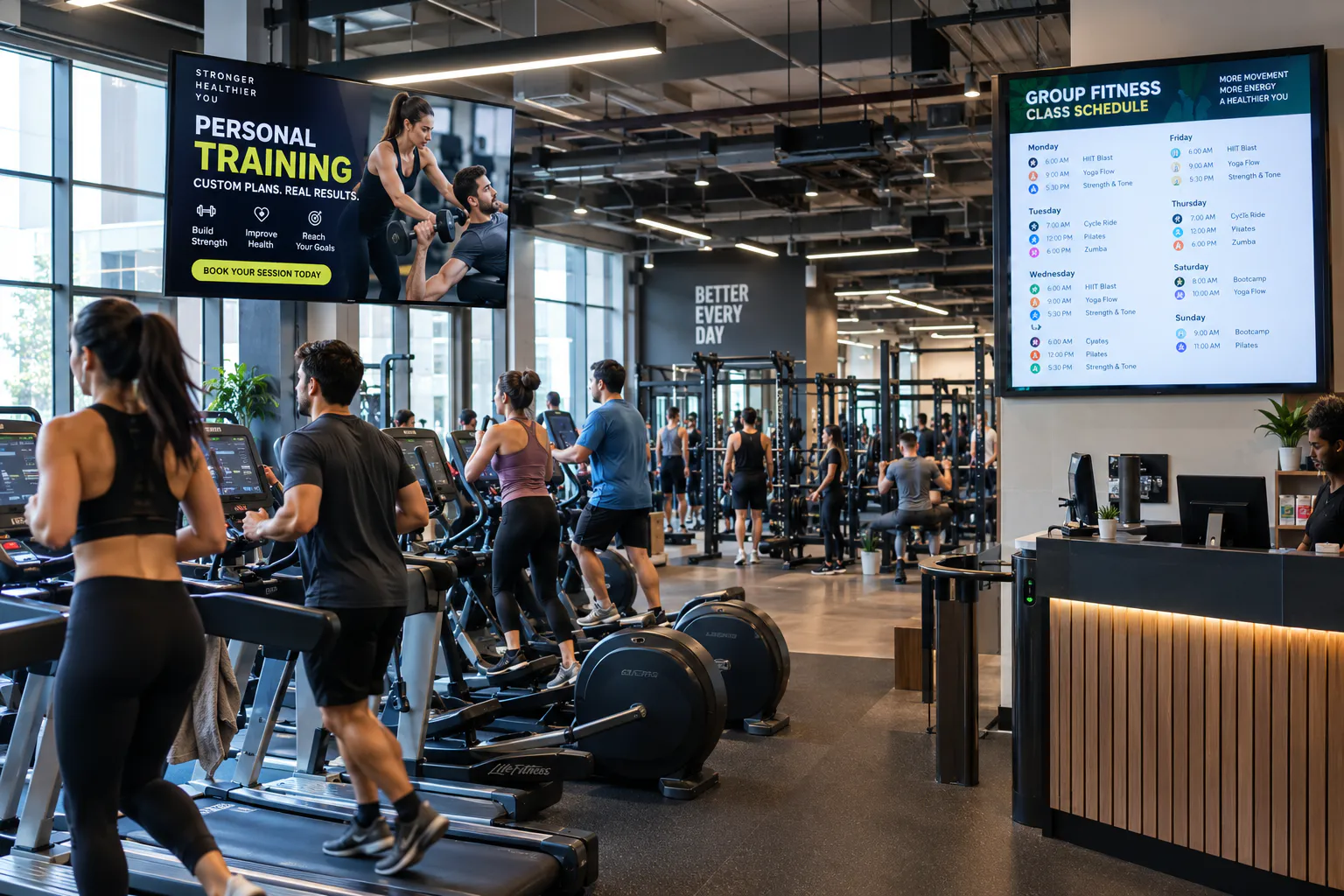
Walk into almost any modern gym and you'll find screens.
Some are mounted above rows of treadmills. Others sit near the front desk, outside group fitness rooms, beside a smoothie bar, or throughout the training floor. Yet many of those screens are still being used like ordinary televisions.
For a gym or fitness center, that is valuable communication space going unused.
Digital signage for gyms gives operators a practical way to turn existing or new screens into communication points throughout the facility. A screen near reception can promote memberships. A display outside a studio can show class information. Screens throughout the workout floor can rotate announcements, personal training promotions, upcoming events, QR codes, or member information.
The important part isn't simply putting more televisions on the walls. It is deciding what each screen should accomplish based on where it is located and who is looking at it.
A member walking through the entrance needs different information from someone spending 30 minutes on a treadmill.
That distinction is what separates useful gym digital signage from TVs that happen to have advertisements playing on them.
Digital Signage Solutions for Gyms
A gym is unusually well suited to digital signage because members move through several distinct areas during a single visit.
Think about a typical member journey:
- Entrance
- Front desk
- Locker room
- Workout floor
- Cardio area
- Studio
- Recovery area
- Exit
Each area creates a different communication opportunity.
That doesn't mean every wall needs a television. In fact, adding screens without a clear purpose can make a facility feel cluttered.
Effective digital signage solutions for gyms start by identifying the locations where members naturally stop, wait, exercise, or make decisions.
Front Desk and Entrance Screens
The entrance is one of the highest-value locations for gym digital displays because nearly every member passes through it.
Useful content might include:
- Today's classes
- Holiday hours
- Upcoming events
- New equipment announcements
- Membership upgrades
- Personal training
- Guest-pass information
- Referral programs
- QR codes for registration or additional information
Keep entrance content simple.
Members may only have a few seconds to see the screen while checking in.
Cardio Areas
Cardio areas offer a very different opportunity.
Someone using a treadmill, stair climber, elliptical, or stationary bike may remain in roughly the same position for an extended period.
That makes nearby gym TV screens appropriate for rotating longer content sequences.
A gym could display several messages over time instead of trying to fit everything into one design.
Weight and Training Areas
Screens around the training floor can be useful for shorter messages such as facility announcements, upcoming events, training services, challenges, or reminders.
Placement matters here.
Screens shouldn't interfere with mirrors, equipment access, sight lines, or the practical use of the training space.
Good digital screens for gyms should feel integrated into the facility rather than added wherever there happened to be an empty wall.
Digital Signage for Fitness Centers
Not every fitness business operates like a traditional large gym.
A boutique cycling studio may have one main workout room. A boxing gym may organize its facility around classes. A yoga studio may want minimal visual distractions. A large health club might have dozens of distinct areas.
That's why digital signage for fitness centers shouldn't be approached as a one-size-fits-all system.
The content and number of screens should reflect the facility.
Fitness center digital signage can be useful for:
- Class-based fitness centers
- Boxing gyms
- Cycling studios
- Yoga studios
- Pilates studios
- Cross-training facilities
- Personal training studios
- Large health clubs
- Recreation centers
- Multi-location fitness brands
For smaller facilities, one or two strategically positioned displays may be enough.
Larger clubs may need a broader digital signage system for gyms that allows screens to serve different purposes throughout the building.
Display Class Schedules & Gym Announcements
Class schedules are one of the most practical applications of digital signage for class schedules.
A printed schedule works, but it is limited by the physical space where it is posted. Members have to walk over to it, and when the schedule changes, the printed version needs to be replaced.
Digital displays give gyms another way to make class information visible throughout the facility.
Where Class Schedule Displays Work Best
Consider placing gym class schedule displays:
- Near reception
- Outside studios
- Near locker-room entrances
- In lounge areas
- Near the main entrance
- In high-traffic hallways
The design should prioritize readability over decoration.
For example:
Someone walking past should be able to understand the information quickly.
For digital fitness class schedules, large text and clear spacing are usually more useful than squeezing an entire week of tiny information onto one screen.
If a schedule contains a lot of information, consider separating it into multiple finished designs rather than shrinking everything to fit.
Use Digital Signage for Gym Announcements
Gyms constantly have information they need members to see.
A class may be moved to another room.
The facility may have different holiday hours.
New equipment might be arriving.
A locker room could temporarily close for maintenance.
A member event might be happening next weekend.
This makes digital signage for gym announcements useful beyond advertising.
Instead of relying exclusively on front-desk staff to repeat information, strategically positioned screens can reinforce important general announcements throughout the facility.
The key word is general.
Don't turn every screen into a wall of notices.
Prioritize information based on how important it is and how long members need to see it.
Promote Memberships, Services & Specials
Members already inside the gym are an important audience.
They may know the facility offers treadmills and weights but have no idea it also provides:
- Personal training
- Group classes
- Nutrition services
- Recovery services
- Premium membership tiers
- Small-group training
- Special events
- Retail products
- Smoothies or refreshments
That's where gym promotional screens can help.
Promote Services Where They're Relevant
Context matters.
- A personal-training promotion near the strength area makes sense.
- A smoothie promotion near the exit or café makes sense.
- A group-class promotion near the studio makes sense.
- A membership-upgrade message near reception makes sense.
Good digital signage for gym promotions isn't simply about showing more advertisements. It's about putting relevant information where members are most likely to act on it.
Membership Promotions
Digital signage for membership promotions can also support:
- Referral programs
- Family plans
- Guest passes
- Annual memberships
- Premium memberships
- New-member offers
- Personal-training packages
Avoid filling every screen with sales messages.
If members feel like every TV is constantly trying to sell them something, the displays can become easy to ignore.
Mix promotional content with genuinely useful information.
Turn Gym TVs Into Digital Displays
Many gyms don't necessarily need to start by buying an entirely new collection of commercial displays.
They may already have compatible smart TVs throughout the facility.
Depending on the television, operating environment, required operating hours, and software compatibility, those existing TVs may be usable as digital displays for gyms.
This can significantly lower the barrier to getting started.
However, operators should evaluate each screen rather than assuming every television is suitable.
Consider:
- Screen size
- Viewing distance
- Resolution
- Brightness
- Operating hours
- Smart TV platform
- Mounting location
- Internet connectivity
- Orientation
A television operating for a few hours in a studio has a different workload from a display expected to remain on throughout a long gym operating day.
For facilities that operate very long hours—or 24 hours—commercial displays designed for extended operation may deserve consideration.
The hardware should match the workload.
Choose Screen Size Based on Viewing Distance
Bigger isn't automatically better.
A huge television in a narrow hallway may overwhelm the space, while a small television mounted across a large training floor may be impossible to read.
Think about the viewing distance first.
A screen immediately behind reception doesn't necessarily need to be 75 inches.
A display intended to communicate across a large open fitness floor may benefit from a larger size.
The same principle applies to the content itself.
The farther members are from the gym display screens, the larger the important information should be.
A design that looks perfectly readable from two feet away on a laptop can become almost useless from 20 feet away.
Always test signage from the member's actual viewing position.
Create Content for People Who Are Moving
This is one of the biggest differences between a gym and many other digital signage environments.
Members are moving.
They're entering the facility, walking between equipment, exercising, talking with a trainer, filling a water bottle, or heading to a class.
They are rarely standing still specifically to read your screen.
That means fitness digital signage should generally communicate quickly.
A useful rule is:
Rule of thumbOne screen. One primary message.
Instead of filling a display with:
Instead ofJoin our personal training program and receive a free consultation with one of our certified trainers. Ask the front desk for additional information.
Try:
TryREADY FOR YOUR NEXT LEVEL?
PERSONAL TRAINING
ASK THE FRONT DESK
The second version can be understood while someone walks past.
That's the environment you're designing for.
Use Split Screens Carefully
There are situations where showing two types of content simultaneously makes sense.
For example, a gym could use three-quarters of a display for a large promotion while reserving the remaining quarter for a QR code, class reminder, or general announcement.
A horizontal screen could also be divided into two sections.
But don't divide a screen simply because you can.
A 50-inch television divided into several small areas quickly becomes a collection of tiny displays.
The more sections you create, the less viewing space each message receives.
For most fitness studio digital signage, one strong full-screen message or a simple two-part layout will be easier to understand than a crowded dashboard.
Schedule Content Throughout the Day
A gym's audience changes throughout the day.
The 6:00 AM crowd may look very different from the 11:00 AM crowd or the 6:00 PM rush.
That makes scheduling one of the more useful capabilities of digital signage software for gyms.
A facility might emphasize morning classes early in the day, personal training during another period, and evening classes later.
Temporary content can also have a defined end date.
For example, if a gym is promoting a Saturday event, the finished promotional graphic doesn't need to continue appearing the following Monday.
With Billiie, businesses can upload finished images or videos, determine when they should display, and set scheduling or end dates.
The graphics themselves are created externally using the gym's preferred designer or design software.
Billiie handles displaying and managing the finished content across the appropriate screens.
Update Your Gym Screens From Anywhere
Managing one screen is relatively simple.
Managing ten screens across a large facility—or dozens across several locations—is different.
This is where remote gym signage software becomes more valuable.
Instead of physically visiting each television, a gym should be able to manage the screens from a central system.
If marketing creates a new membership promotion, the finished graphic can be uploaded and assigned to the appropriate displays.
If only one location needs an announcement, it can be assigned accordingly.
If a promotion should appear on several screens, those screens can receive the same finished content.
Remote management removes much of the repetitive work that can make larger signage networks difficult to maintain.
Assign Screens to Gym Managers and Team Members
Not every screen needs to be controlled by the owner.
Imagine a fitness company with five locations.
The owner may want overall visibility, but the manager of each facility may need responsibility for the screens at that location.
A studio manager might handle class-related displays.
A marketing employee might handle promotional screens.
This is where screen-level responsibility becomes useful.
With Billiie, screens can be assigned to team members so the appropriate person can manage the displays they are responsible for.
That is especially useful for digital signage for multiple gym locations.
Instead of one person becoming a bottleneck, management can be distributed while the organization retains a structured system.
Manage Multiple Gym Screens From One Dashboard
A growing fitness business should think beyond today's number of screens.
One location might begin with:
- One reception screen
- One cardio-area screen
- One studio screen
That's only three displays.
Expand to five locations and the organization may now be responsible for 15 screens.
Add more displays per facility and the network grows quickly.
Multi-location gym digital signage should make that growth easier to manage—not harder.
A centralized dashboard helps operators understand which screens belong to which locations and manage content accordingly.
Screen status is also important.
If a screen is offline, the ability to identify that remotely can save time compared with discovering the problem days later during a physical visit.
Digital Signage for Fitness Studios
Smaller studios often benefit from a different approach.
A yoga studio, Pilates studio, cycling studio, or personal-training facility may not need screens everywhere.
One carefully positioned screen can potentially handle several communication needs throughout the day.
Digital signage for fitness studios might be used for:
- Today's classes
- Instructor information
- Upcoming workshops
- Membership information
- Studio announcements
- QR codes
- Special programs
- Retail products
For a boutique facility, restraint is important.
A screen should complement the environment rather than dominate it.
This is particularly relevant for wellness-oriented studios where atmosphere is part of the customer experience.
Digital Signage for Health Clubs
Larger health clubs often have more complicated communication requirements.
A single facility might include:
- Fitness floors
- Group exercise studios
- Pools
- Saunas
- Locker rooms
- Childcare areas
- Cafés
- Recovery areas
- Sports courts
- Personal-training areas
That creates more opportunities for digital signage for health clubs, but also makes screen organization more important.
Health club digital signage should be organized by area and audience.
A message about pool hours doesn't necessarily need to occupy every screen in the building.
A café promotion doesn't need to appear in every studio.
The ability to target finished content to relevant displays helps keep the signage useful rather than repetitive.
Don't Forget Screen Status and Power Settings
One of the least glamorous parts of digital signage is also one of the most important:
The television has to stay on.
Consumer smart TVs may have screensavers, sleep timers, automatic power-saving modes, or "still watching" features.
Those settings can interrupt signage during business hours.
Before deploying digital signage for gyms and fitness centers, check the television settings and test the screen through a normal operating day.
Remote screen status can also help identify when a display has gone offline.
If a screen at another location hasn't been connected, management can investigate instead of assuming everything is running correctly.
Affordable Digital Signage for Gyms
The cost of signage can increase quickly when businesses assume every installation requires expensive proprietary hardware and complicated infrastructure.
It doesn't always.
For many indoor fitness businesses, affordable digital signage for gyms can begin with compatible smart TVs, existing internet access, appropriate mounting, and cloud-based signage software.
The right setup depends on the environment.
A small training studio may have very different hardware requirements from a 24-hour health club with dozens of screens.
The goal should be to pay for what the facility actually needs.
Not what a complicated signage system says every business should need.
per month
- 1 screen$1/mo
- 10 screens$10/mo
- 100 screens$100/mo
- Includes your first screen
- No long-term contract
- Cancel anytime
Affordable Digital Signage Software for Gyms
Software should make operating screens easier.
If employees require extensive technical training every time they need to display a new finished promotion, the system can become more trouble than the screens are worth.
Billiie's workflow is intentionally straightforward:
- Create
- Upload
- Assign
- Schedule
- Display
- 1Create the finished image or video using your preferred designer, ChatGPT, Canva, or another design tool.
- 2Upload the finished file to Billiie.
- 3Choose the screen.
- 4Set the schedule or display period.
- 5Then manage the screen remotely.
Billiie isn't an in-platform graphic editor. It doesn't require businesses to rebuild their designs inside the signage software.
Instead, businesses upload finished content and use Billiie to control where and when it appears.
That makes it a practical option for businesses looking for straightforward fitness center signage software without turning every content change into a technical project.
Digital Signage Solutions for Fitness Centers Should Scale With the Business
The best digital signage solutions for fitness centers aren't necessarily the systems with the longest feature list.
They're the systems that fit the way the facility actually operates.
For one gym, that might mean two screens.
For another, it could mean 20.
For a growing fitness brand, it could eventually mean hundreds of displays spread across multiple locations.
The underlying questions remain the same:
- 1What is this screen supposed to communicate?
- 2Who needs to see it?
- 3Where should it be installed?
- 4Who manages it?
- 5When should the content appear?
- 6Can management tell whether the screen is online?
Answer those questions before worrying about adding more displays.
A screen should have a job.
Final Thoughts on Digital Signage for Gyms
The strongest digital signage for gyms doesn't try to turn every wall into an advertisement.
It improves communication throughout the facility.
A front-desk display can welcome members and promote services.
A studio screen can communicate class information.
A cardio-area display can rotate promotions and announcements.
A strategically placed QR code can move interested members from the television to their phones.
And a centralized digital signage software for gyms platform can make those displays easier to manage as the business grows.
Start with the member journey.
Identify where people naturally look, stop, wait, and exercise.
Give every screen a purpose.
Keep the content readable.
Schedule information when it's relevant.
Assign responsibility for the screens.
And choose technology that doesn't make a simple communication task unnecessarily complicated.
That's what turns a collection of TVs into a useful digital signage system for gyms.
Affordable. Digital. Simple.
Just $1/month per screen — every screen, including your first.
Start Your Gym Digital Signage